Wednesday, April 11, 2012

Bay Islands

Guanaja
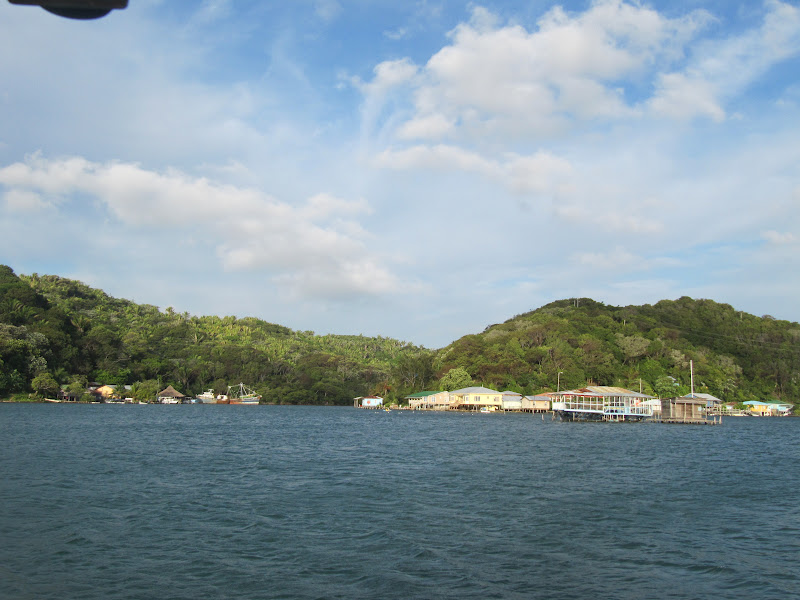
Thursday, March 15, 2012 (well it’s really April 11, but we’re getting closer) we have dropped our anchor in Sandy Bay, Guanaja one of the Bay Islands of Honduras. A sail of 150nm from the Vivarellos taking us 29 hours. We are ready for a nap. Upon arriving at Guanaja we first head to the Settlement to check in. The Settlement is the main town of the island; actually the Settlement takes up most of a smaller island a stones throw off the main island. Way back when the folks that settled here set up their settlement on the smaller island to give themselves a sense o safety and protection, from then the name stuck. This is one of the centers of the Bay Islands fishing fleet and not a location to spend a night at anchor, there is far too much boat traffic. We quickly drop the dink and head into town to visit Immigration and the Port Captain. The Port Captains office is at the town dock, however before visiting him you must first find your way to the Immigration office (bring copies of your passport as well as a copy of your zarpe from the last port of call, two copies of each should do it). From the Port Captains office head up the alley to the “main road” and hang a right, keep walking until you find the Immigration office on the right; it’s a five minute walk. Also, be sure to have the entire crew come ashore, otherwise a trip back to the boat to gather them up will be required. After finishing up with Immigration, we head back to the Port Captain for our entry papers at a cost of US$ 10. 
sunrise Sandy Bay
After so much stress we stop for a refreshment at a local establishment and catch up with some cruisers who call Guanaja home. It is from this group that we learn of the anchorage at Sandy Bay, a short hop east of the Settlement. After nearly two months of rockin-n-rollin at anchor or underway we have found PARADISE. With not a ripple across the bay and a clear night sky we crawl into the v-berth for a good afternoons/nights rest. The evening proves to be cool requiring the addition of a blanket to the bed, allowing for a wonderful twelve hours rest.

fishing fleet
Our first order of business is to resupply the fresh water tanks to allow for showers and laundry. For this we head into the Manati Bar and Restaurant, a short few hundred yards off the stern of Boto. Claus and Annette run the Manati and offer fresh water at their dock gratis; of course we felt the need to be hospitable so we joined them for a nice liter of Bavarian Dark beer and some onion pie. Claus and Annette are from Germany and have been in Honduras and the Bay Islands for a couple of decades; however they still manage to import some of their favorite gastronomic items from the fatherland.


chillin' at La Giralda
 With water topped off and chores done for the day we are ready to relax, but first a visit from the folks at the La Giralda resort (www.bayislandhotel.com). They’ve stopped by in their run-about to invite us to the Friday Night bonfire complete with coupons for a free drink and to offer us a complimentary bag of ice. The folks at La Giralda know how to get our attention. Guanaja is quickly becoming one of our favorites.


the local highway

a side street
We mentioned the resorts run-about, this needs further explanation. Other than the pedestrian walkway on the Settlement, the island of Guianaja has only one road. That road is a one mile stretch between two of the villages on the north side of the island, otherwise there are no roads. The primary mode of transportation is water craft, followed by foot power.


beach combing


While the south side of the island boasts most of the population, if heading to Guanaja we suggest spending some time on the north side as well. Although the north is fringed by coral reef a nice clear day with good visibility makes it an easy trip. We take the 20nm trip around the island to drop anchor off Michaels Rock. Here we find excellent hiking and snorkeling as well as simple beach combing. The north side offers a great expanse of white sand beach in and of itself worth the trip. Of course we also went for the waterfall (well more of a junior waterfall, but fresh cool water none the less).


With a week’s rest behind us it is time to carry on heading west to the island of Roatan. The weather these last few months have been ideal for sailing, actually using the white hankies that make us a sailing vessel. The trip to Roatan is no exception; we cover the 30nm in five hours sailing downwind in 15-20k of breeze.


the falls

Bubba at the falls
Our first stop is Jonesville Bight. As we approach to cut into the bight the wind calms down as does the swell allowing us to make out the channel through the reef quite easily. The cut requires us to put a little “English” on our entrance in order to avoid the shoals to either side, of course just as we make our turn to head through the cut the wind kicks up to 20k pushing the swell over the reef making for a fun filled surge into the anchorage. We make it through with the depth rising to ten feet before dropping off again to fifty; always have enjoyed entering a new anchorage. Jonesville is a nice introduction to Roatan, a little busier than Guanaja but not quite so much as French Harbor. Next up for us is French Cay Harbor, for those heading this way make your way into French Cay Harbor rather than French Harbor, the later is primarily commercial in nature. There are some buoys in French Cay however we opt for our anchor as a known quantity. There is a beautiful marine park off our anchorage which offers some nice snorkeling and there is always the resort ashore for volleyball, BBQ, WiFi, Happy Hour, Pot-lucks (reminds us of the Bahamas).

Jonesville Bight

Jonesville school bus
 After three years cruising we rarely just go sailing, actually we never do. However, we met a couple from Colorado at the resort who expressed an interest in sailing so we invited them aboard. With little forecast for good wind we head out of the anchorage for a few hours tour. To our surprise the wind picked up we shut off the engine and just sailed for two hours with now destination in mind, just following the wind. What a great day we had, just enjoying the sea and sun. Odd how even life on the water can become routine after a while, it was great to be reminded of how much we enjoy being on the water.

the end of a day sail


Once again we are off, this time to Utila the last and most westward of the Bay Islands and our jumping off point for Guatemala. Although we had planned on staying in the Bay Islands for a while longer the weather window for heading west is too attractive to pass up. Planning a few days stopover in Utila before making the overnight passage to the Rio Dulce we bid Roatan farewell on March 29. If asked and we were, to rate the Bay Islands we would have to put Guanaja first, Utila second and Roatan third. Keep in mind that the three islands have very different environments. Guanaja being remote and relaxed, while Roatan offers more of a tourist/city destination (however keep in mind this is still the Caribbean) and Utila is somewhere in the middle.

While on Utila we manage to take in a few dives with the folks at Parrot Dives while also enjoying some very good meals ashore. The Driftwood Grill on the west side of East Harbor offers Texas BBQ. As the bar/restaurant is owned by a couple of expatriate Texans the dry rub ribs are the real deal. However, the fish sandwiches are awesome.

Diamond Cay
With a good weather forecast and the urge to get going again we relocate ourselves to the west side of Utila and an anchorage behind Diamond Cay. Once again we have to thread the needle between reefs, this time we were able to follow a couple of dive boats through the cut. After the music and parties of East Harbor, the anchorage at Diamond Cay is a welcome respite. We’re able to get a good night’s rest and are off for Guatemala the morning of April 3. With a forecast of NE/SE winds in the afternoon and evening of 10-15k and light and variable in the mornings we figure to have a nice days sail on Tuesday the 3rd, likely having to motor the last 10-20 miles on Saturday the 4th of April. Ah, the best laid plans….


Diamond Cay sunset


Monday, April 9, 2012

North to the Bay Islands

Albuquerque Cays, Colombia
It’s April 9 and we have made our way to the Rio Dulce, Guatemala, it is time to catch ourselves up as we have been without the wonderful world of the interent since leaving Panama two months ago.

Weather: Everyone makes plans according to the weather, we just happen to rely upon the forecast now more than we ever did ashore. The forecast for the week of Feb. 12th for the SW Caribbean Sea is NE winds 10-15k with 4-6 foot seas out of the NE. Departing Portobelo, Panama at 1830 hours Sunday February 12, we head out into the Caribbean Sea and for the next forty one hours we experience 15-20k NE winds gusting to 25k with 6-10 foot seas from the NE. All in all things turned out to be great weather wise. Avoiding the big ships coming out of the Panama Canal proved to be the biggest headache, they apparently do not recognize a sailboats right of way.

Boto at Albuquerque Cays
Our first stop on our way to the Bay Islands of Honduras is Cayos de Albuquerque, Colombia. The cays are two small islands within a coral reef 211nm from Panama, 100nm off the coast of Nicaragua, basically in the middle of nowhere. We arrive and are anchors down by 1130 Tuesday Feb. 14. Once again we have stumbled across a little slice of paradise.

With the anchor firmly set we are off in the dinghy to visit the Marine base on North Cay. The cays are owned by Colombia and they maintain a military presence in the form of nine Marines. As we approach the beach the entire squad turns out to meet us. The group spends thirty days on the island before being relieved, as far as military rotations go I imagine there are worse. We present our papers and the officer in charge makes note in the log book, then we are asked to return to Boto. We are not allowed to tour the military island but are welcome to visit the fishing camp on South Cay.

South Cay is a heavily wooded island with several lean-too structures giving the fisherman protection from the elements. Unlike the north island which has a good stretch of sandy beach, the south island has a small sandy landing area the balance is coral and rock. We manage an abbreviated tour and then back to the boat. During our stay we are offered no fish although the fishing boats come by to say hello and to ask for cigarettes.

The Albuquerque’s are our first stop in the middle of nowhere, literally. As the sun sets the only lights are from the flashing beacon atop the radio tower on North Cay and the occasional flashlight from the fishing camp. We have front row seats as the stars begin to light up the night sky. As we enjoy the scene above we are equally entertained by the iridescent jellyfish floating around Boto. At first we think we are imagining things as the pink lights flash on and off, once we realize what they are Vicky decides against swimming.

A few days of rest and we are ready to head out again. With the afternoon sun high overhead we weave our way back through the reefs surrounding the cays and make our way to deep water. Just as we clear the outer reefs the Colombian Coast Guard happens along. We’re certain that they have been notified by the Marine base of our presence and are just checking on us. The twenty foot skiff has likely come from San Andreas a larger Colombian island some 25 miles north. Fortunately the wind is up and the seas are high discouraging the Coast Guard from wanting to board us. Instead they take our information via radio and wish us well. We encounter the Coast Guard again as we pass the island of San Andreas. That meeting takes place with another twenty foot skiff after dark and is a little more exciting.

There is a good deal of commercial traffic along our route so we have something to keep us busy along the 85nm to Providencia. Having confirmed the availability of diesel on Providencia we decided to bypass the more tourist orientated island of San Andreas, we’ve had our fill of tourists for a while. After once again relaying our particulars to the Coast Guard via radio we are bid safe travels.

rush hour, Providencia, Colombia
Our planning so far seems to be working out well as we arrive in Providencia at 0900 on 2/17 just after a brief squall rolls through. We received a note of concern from some friends who have been keeping track of us. Our anchorage in Providencia, Colombia at first appears to be in the middle of the ocean. That is correct. We assure them that we are ok, just stopping of for another dose of paradise on our way north.

one of the locals

Chula and friends
 Safely nestled within the worlds third largest barrier reef at 13*22.8N 81*22.4W are the islands of Providencia and Santa Catalina once the home to pirates and privateers, we call them home for now. We contact the Busch agency who will process all of our paperwork for entry and exit of Colombia and are promptly requested to come ashore to meet them. With Eduardo of the Busch agency, Justin the Port Captain and Javier of immigration along with Ed at the tiller our dinghy is riding very low heading away from the docks. The process is SIMPLE, in spite of all stories we have heard to the contrary. The fee to check into Providencia is $US 60. There is however a tourist fee if you plan to spend more than twenty four hours, this is US$ 25 per person. If you also visit San Andreas you will have to clear in as well paying the customs fee but not the tourist fee. The gang joins us for coffee and cookies, they loved the cookies while processing our paperwork in between bites.

our back yard
Providencia
A short trip to shore to get our bearings reveals that our Spanish 101 will work on occasion, so will English. As for the Spanish Creole, we simply smile politely and respond in Spanish. Having stretched our legs and restocked the bread shelf it’s time for a nap.


the girls, Providencia
 Saturday, February 18. 2012; although we do not often listen to the news, we do catch bits and pieces, today we hear of the death of Gary Carter at the age of 57.

Our private beach
The real adventure doesn’t always take place on the high seas, usually it is while we are in the dinghy exploring and island. In this case we are rewarded with a remote beach on the north side of Catalina Island. Chula is in heaven as there are coconuts and more than enough room to chase her ball. We’ve brought along chairs to simply sit and enjoy the view.

bounty of the sea


While not a high end destination Providencia has much to offer to the everyone. We met several folks renting homes along the bay simply enjoying the quite. For the boats we are able to load fresh water compliments of Mr. Busch’s cistern and top off our diesel and gasoline supplies. In all instances be prepared to walk. We carry the jerrycans of fuel and water making great use of the old luggage rack that Dad supplied last summer, the wheels may wobble some but it can carry 80lbs of H2O.


Our friend the Octopus.

As we and several other boats are more or less trapped by the weather outside we all have time to enjoy the island. To that end we are invited to an impromptu concert in the town square. Among the musicians is the Mayor on mandolin. In addition to the mandolin, the group boasts two guitars, maracas and “teeth”. The teeth are the jawbone of a large animal, perhaps one of the cows we see being herded around the island.

homemade music

While the winds continue to howl, we’ve registered 37k in the anchorage we sit back and read, tour the island or enjoy the beach. B Y now Chula is recovering nicely from her knee surgery and spends every day on the beach running and swimming. While the high winds may keep us harbor bound it does not reduce our ability to socialize. The only thing is that the get together can sometimes be a bit odd, as with the March 7 meeting of Phillipe and Cathi aboard “Tangerine Dreams”. Tangerine Dreams literally bumped into us at 0200 on the 7th when their anchor gave way and the boat floated back into Boto. Fortunately their dinghy was raised off their stern and it served as a large fender. After getting them untangled from our bow, we all returned to sleep. This was a major victory for Ed, as he went back to sleep and did not stay up all night worrying. Later that afternoon we were treated to food and drink aboard Tangerine Dream.


Under sail

HMCS GOOSE BAY
It has been 23 days and we have truly enjoyed Providencia, but the wind and seas have calmed and we are ready to depart. Of we are at 0300 on March 11 bound for the Viverellos Cays, another 200nm sail. Arrivning at the Viverellos at noon on the 12th we are ready for a rest. The sail was simply great one of the best ever. In spite of the fair winds and friendly seas the highlight came at 0730 on the 11th when over the VHF radio we heard; vessel at 13*46.350N 81*30.480W bearing 343* at 6k (this would be us SV Boto) this is the Canadian WARSHIP 707(aka "HMCS GOOSE BAY". That’ll make ya clinch. The Canadina Navy along with the US Coast Guard are patrolling the NW Caribbean and simply wanted to know who we were and where we were going. While we have been hailed and even boarded by the Coast Guards of various countries this was our first experience with a Warship. The 707 covered the 7 miles between us very quickly, came along side for a visual check of us and then turned on a dime and sped off in the other direction, a little bit of show boating there. Well at least we were not alone. Oh, and yes she has canons.

Viverellos
Once again anchored within a group of coral islands, the Viverellos provide a spectacular view and great protection from the oceans swell. It is always amazing to find an oasis of land in the middle of the ocean. These islands are uninhabited except for small fishing villages populated during the season. We are offered shark but no lobster, oh well. While I enjoy shark, the tiger shark in the small fishing boat was just too big for us.

With a mere 150nm left to reach the Bay Islands we are up and off at 0600 on March 14th. Once again we are able to sail nicely throughout the day, however by nightfall the wind is behind us and it is time to motor sail. Arriving at the island of Guanaja at 1100 on March 15th we clear into the country at the Settlement then retire to the anchorage of Sandy Bay. It is a clear and calm afternoon and evening turning almost chilly. With the hills blocking the NE winds and the oceans swell there is nary a ripple on the Bay as we drop our heads and fall fast asleep. After several months of high winds and choppy anchorage we have managed to sail 650nm to find a good night sleep.

Well, we have arrived at the Bay Islands of Honduras, we are now as close as we have ever been to being current with this blog, so stay tuned.
somewhere over the double rainbow

Tuesday, March 27, 2012

Portobelo, Panama

ahhh, Paradise
It’s 2012, a new year with new ports of call for Boto. After spending a month in the remote San Blas Islands we are ready for a little city life. For us this means motor sailing the 50nm to Portobelo, Panama. Although we had plans of stopping off along the way at the Turtle Cay Marina where we hoped to enjoy unlimited fresh water and electricity, after viewing the entrance to the bay which feeds into their channel we changed our mind. The winds were north at 25k, directly into the bay. The swell was out of the NE with 8-10’ rollers, again right into the bay. The wind and waves combined to make the entrance very unattractive, so we continued on to Portobelo.

Portobelo
 There is a lot of history to be shared regarding the Pueblo of Portobelo but first let us talk of our first meal ashore. We anchored in 20’ off of the town, later we will relocate due to poor holding. We clean ourselves up, grab Chula and head to Captain Jacks. Captain Jack is an old pirate who has set up a bar/restaurant/hostel here in Portobelo. For us this means a Cheeseburger and Fries, plus a coldie. While most burgers are good and our Boto burgers are great, nothing really compares to a well made burger cooked and served by someone else. These are good burgers. Jack greeted us with a warm smile and a big hello while the other cruisers were happy for new faces to tell their stories to. Chula was happy because Jacks is puppy friendly and between Vicky and I there would be extra fries. Although we have her on a diet we had to indulge her, after all she was out there in the wilds too.

"Boto" and Cap't Jack
 With our stomachs full and our bodies tired we returned to Boto for a nights rest. In the course of one hour, specifically 9-10pm we re-anchored twice. The anchor alarm going off the first time just as Vicky said, “I think we’re closer to that boat”. The 5th of January dawned grey and humid along the coast of Panama. Although we enjoyed being close to the town and its supply of free (kinda) fresh water we finally succumbed to the poor holding and the unending ocean swell which rocked us. At 1700 we pulled anchor and relocated to the north side of the bay under the battlements of Bajo Fuerto San Fernando. Here the swell is much gentler, the breeze cooler and as we came to find out the howler monkeys much louder. We also became neighbors with an old aquaitence from Santa Marta, Colombia. The catamaran “Meow” was next door and remained so for the next six weeks, Gino and Mel are good people.

If sailing along the coast of Panama, east to west we suggest leaving the formalities of checking into the country until you reach Portobelo. There is no formal check in process for the San Blas Islands other than the occasional contribution to the Kuna Yala and the Immigration and Port Captain in Portobelo make things very easy. Although, you will have to travel to Colon at some time in order to obtain your cruising permit for the country. This task became a non-issue once we learned of Captain Jacks weekly ride into Colon. Jack will offer a ride for $25/person into Colon, anywhere in Colon. Although the bus ride at $1.60 is cheaper, if you are planning to provision, as we did, Jack’s pickup truck is a much better deal. The taxi ride one way from Portobelo to Colon is $30. So off Vicky went with Jack, Mel from “Meow” and Phil (?). It’s a good thing Phil went along too. He speaks fluent Spanish and the check in process for the permit was very simple. Onto the large supermarket to load up on groceries. Although the stores in Colon are well stocked, the Rey in Sabanitas is just as well stocked and a half hour closer than Colon. The catch of course is that you will most likely be taking the bus to Sabanitas, so plan accordingly.

Portobelo, another era of sailing ship
 The Spanish Main. This simple phrase conjures romantic visions of Swashbucklers and Gold. Portobelo was a prominent part of the Spanish Main and its history. Columbus discovered the bay in 1502 and named it Puerto Bello (beautiful port), later her name would meld into Portobelo. Towards the end of the 16th Century Portobelo became base for Sir Francis Drake during his raids on Spanish merchant ships. In 1590 he attacked and destroyed the Spanish fortifications that had begun construction here, during this time he died and his lead coffin is said to reside under the sea just off of the islet bearing his name.

Fort San Geronimo
 In 1597 Portobelo became the gathering point for all of the wealth gathered by the Spanish from South America. The mule trains would bring the cold and silver to this port where it would later be shipped to Spain. This gathering of wealth attracted many a pirate including Henry Morgan (we’ll talk more of him later during our stay in Providencia, Colombia). In spite of the buccaneer raids the port continued to thrive into the 18th century. In 1739 the British destroyed the forts of Portobelo and the Spanish Crown never rebuilt this commercial center. The ruins of these forts would have one last moment in the sun as the rock material was used in the construction of the Panama Canal in 1904.


Church of the Black Christ
 In 1776 when the United States was declaring its independence, the church of the Black Christ was being constructed in Portobelo. Every October a fiesta takes place for the Black Christ, the patron of pickpockets as well as others.

While the history lies in ruins around the bay, one can easily imagine a time when large merchant ships and Spanish Gallons anchored in these waters. Today there are 40-50 modern day pirates anchored in the bay among them is S/V Boto. Now back to the 21st Century.

Portobelo
 We’ve mentioned the buses a few times so let us give some details. The buses are old Blue Bird school buses that have been decoratively painted inside and out. Unlike the school buses of our childhood, standing in the isle is ok, especially as the “pusher”/fare collector crams as many souls as is possible into the bus to make the most of the run. For the run from Portobelo to Sabanitas the fare is $1.50 and will take about an hour. Colon is another 30 minutes and an additional $0.10. Once you arrive in Colon it is your choice take another school bus to Panama City or hop on an express bus, complete with air conditioning and movies. The fare to Panama City is $3.15 and takes about two hours. As an option, you can get off in Sabanitas and flag down the first Panama City bus that you see, odds are you will be sitting in the isle on an upside down five gallon drum, but you’ll save the thirty minutes into and out of Colon.


Our first bus excursion came with the invitation from the“Happy Bird” to serve as line handlers during their transit of the Panama Canal. The “Happy Bird” is a sister ship to Boto circa 2004. We have kept happy company with Roderick and Yvonne since our first meeting in Bonaire. After confirming their transit date and that Chula was also invited we prepared to join them in Colon on Jan. 10.

Rodderick and Yvonne
aboard "Happy Bird"
The transit had been originally slated for the afternoon of the 10th, however it was pushed back until the evening of the 11th. While we were comfortable aboard, Chula was even more so, taking her normal stroll to the bow to take care of things. This gave Roderick some pause, but we promptly cleaned things up and continued with our reunion. Our pilot/advisor arrived at 1900 hours Wednesday the 11th and we were off for the canal entrance.
approach to the locks
 Hector “the Protector” was brought along side in a launch and directed us into the channel leading to the first set of locks. As we fell in behind a freighter we rafted up with another sailboat. Rafting is the tying of boats to one another bow and stern plus spring lines midship. In this fashion we would be going through all of the locks with the “Happy Bird” providing all of the steerage and power from her larger diesel engine.  As we entered the first of three locks for the evening transit everyone was excited and nervous. By the end of the following day we would all be old hands at the canal transit. The first three locks raised us over 80 feet to Lake Gatun where we would spend the evening at anchor. Hector left us at 2300 hours to head home and we all turned in awaiting the 0530 alarm on Thursday morning.
entering the first lock, that's Ed


sunrise on Lake Gatun
alligator (left) and crane
Up with the sun and our new advisor joins us for the voyage across the lake to the next set of locks that will bring us to the Pacific side of Panama. Motoring across the lake we take in the wonderful views including alligators and birds. The trip itself reminds Vicky and I of our trip through the Gulf Coast states along the ICW in 2009. The last three locks were easier to handle as we were descending from the lake so there was nothing to do but pay out the lines as we dropped. Our final resting place after 20 hours was a mooring ball of the Balboa Yacht Club. Here we left “Happy Bird” to continue her voyage into the South Pacific, while we ventured into Panama City for a visit with a Veterinarian.


crossing the lake
keeping busy
 Our first mate, Chula had been limping on and off for a few months, since our time in Santa Marta, Columbia. At first we thought/hoped she had sprained a foot or pulled a muscle. However, as time went on her limp became worse. After much input from other cruisers we decided to take her to the Veterinario School of the University of Panama. Of course as with the best laid plans, we could not find the school. Luck was with us and we ended up at the “Cats and Dogs Care Center” where Dr. Carmen de Solis was a tremendous help. After her initial examination she called in a consulting surgeon to exam Chula’s hind right leg, more specifically her knee. Chula had ruptured her Cranial Cruciate Ligament, similar to a person tearing their ACL.

After much discussion during which time we viewed several different videos showing how the rupture can be repaired we decided on a treatment and surgery was scheduled for Saturday Jan 14. As we had left Boto under the watchful eye of the crew of “Meow” for a week we decided that Ed would head back to Portobelo to check on things while Vicky stayed in Panama City with Chula. This gave Vicky a chance to revisit the days of her youth by staying at various hostels throughout the city. Chula’s surgery went without a hitch and she spent the following week at the clinic with daily visits from Vicky.

Panama City
 If you find yourself in Panama in need of a Vet we highly recommend the folks at the Cats and Dogs Care Center. The taxi ride from downtown Panama City was US$4-$5.

Dr. Carmen de Solis (speaks very good English too)
P)507-260-0991 C) 6612-9015
Ave. Ernesto T. Lefevre #86 at the corner of Santa Elena.

Back in Portobelo the weather had kicked up with 25k winds, rain and white caps in the bay. Vessels were dragging anchor left and right; from the 30’ Elsa dragging next door to Boto, to the 100’ Dutch Schooner serving as a School at Sea. Fortunately, Boto never budged from her position.
Luna's Castle
 
Finally, with Chula’s hospital stay coming to an end, Ed returned to Panama City and Luna’s Castle Hostel to meet up with Vicky. Of course there was first a stop at the Vets to visit the puppy. Luna’s Castle is located in the old town section of the City and it is a great location. We wandered round the small cobblestone streets taking in the old buildings, churches and water front. We manage to make the best of the situation by enjoying the city. Let us not forget the all you can eat pancake breakfast at the hostel.

Picking up Chula at 1130 on Friday the 20th of January we make our way to the National Bus Terminal via taxi. Our driver to the terminal alternated between universes, perhaps even more than two while he negotiated the streets and regaled us with stories in English, Spanish and some other Galactic tongue. Chula posed for pictures before boarding her luxury express bus for Sabanitas. Truly, as we checked with the driver to make sure it was ok for her to ride the bus out came the cameras and click went the photos. We finally made it home at 1630, five hours later. As Chula made herself comfortable we went about making the boat patient proof. Her stitches came out on Tuesday the 24th, compliments of her crewmates.

"I'm in recovery....."

I want pain meds!
 As Chula recuperates and we await a weather window for heading north life returns to normal. Laundry requires the hauling of water. Putting on diesel, gasoline and propane (actually in Panama it’s Butane). Gathering the paperwork to prepare our taxes, yes even in paradise one cannot escape the realities of life. In between our chores we have the chance to explore the area a little further. Following the Rio Clara into the mangrove swamp; climbing the hills around the bay to explore the fort ruins or just strolling through the streets to give Chula as well as ourselves a little exercise.

the mangrove swamp
 As January draws to a close the weather continues to be gusty and wet with more boats dragging around the bay, we continue to stay put. Chula improves every day and we are getting anxious to pull anchor and head out again. With the beginning of February comes the Superbowl and a change in the weather. We join a few folks to watch the game at Captain Jacks, although we were unable to see any of the TV ads from the US. Oh well.

A man, his dog and his cannon
As we have talked about previously one of our major decisions for the new year has been to sell Boto and return to terra firma. We place several ads online for Boto as well as a detailed description on the blog. We have had a number of inquiries with an increased amount of traffic to the blog, perhaps we’ll come across a good soul to take over where we leave off with Boto.

local transportation

local commute
Well, with fuel and water topped off and a good weather window for the coming week we are off. Sunday February 12 we depart Portobelo at 1830 hours, heading out for the first time in over a month for the 200nm sail to Cayos de Albuquerque, Colombia.

BOTO under fire